A zodiac print at 40 by 60 inches
By the Painted Zodiac studio · · updated
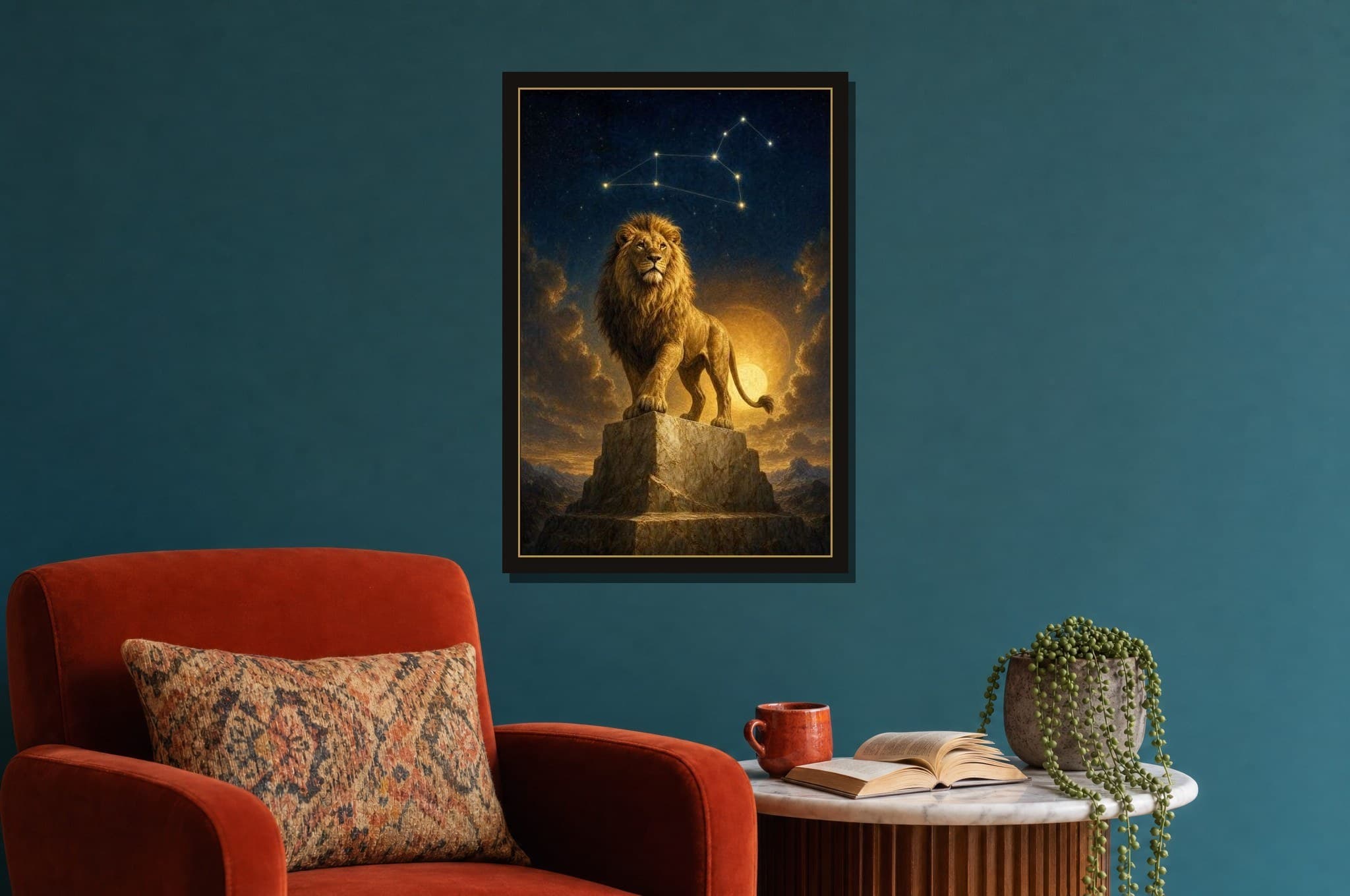
Forty by sixty inches is a little over a metre by a metre and a half. Hung with its bottom edge at the height of a sofa back, the top of it is above most people's heads. At that size a zodiac print stops being a picture on a wall and starts being the wall.
It is also the size at which most of the category stops. Here is the largest print each shop lists, from their own pages, read on 23 September 2026.
| Shop | Largest print listed | Source |
|---|---|---|
| The Night Sky | 24x32 in | thenightsky.com |
| Under Lucky Stars | 24x36 in (listed at $250) | underluckystars.com |
| Mapiful | 24x36 in | mapiful.com |
| Society6 (one zodiac listing) | 30x40 in (listed at $125, unframed) | society6.com |
| Painted Zodiac | 40x60 in, on four formats | the twelve |
Twinkle In Time, Positive Prints and Desenio do not publish a largest size on the pages we could read, so they are left out rather than guessed at.
Four formats at the top rung
At 40x60, Painted Zodiac offers the same four wall formats as at every other size, each printed to order by Prodigi:
| Format | 40x60 in |
|---|---|
| Archival Giclée Print, 200gsm Enhanced Matte Art | $749 |
| Hahnemühle Fine-Art Print, 308gsm Photo Rag, 100% cotton | $829 |
| Gallery Canvas, stretched | $969 |
| Framed Gallery Canvas, black floating frame | $1,199 |
Shipping is $12 flat on the order, at this size as at any other. The prices are read from the shop's catalogue when this page is built.
These are not small numbers, and they are not meant to look like it. A 40x60 print is a large physical object made one at a time, and the price reflects the print, the stretcher bars or frame, and the work below.
The problem with printing large
A print is only as sharp as the file behind it. The usual measure is dots per inch at the finished size: the number of pixels across, divided by the inches they have to cover.
Most of the house's rectangular paintings are mastered at 2,336 by 3,504 pixels. That is plenty for a 12x18 print: 3,504 pixels over 18 inches is 195 dpi. Stretched over 60 inches, the same file is 58 dpi, and a studio commission, which comes back from the image model at 1,536 pixels on its long edge, would be 26 dpi. At that density a print is visibly soft from across a room, and soft is not what anyone pays for a five-foot piece to be.
So the shop sets a floor of 150 dpi and refuses to offer a size that cannot meet it. Every paid print file is checked against its size when the order comes in. If it is already big enough, it goes to the printer as it is. If it is not, it is enlarged before it goes: to 9,000 pixels on the long edge, which is exactly 150 dpi at 60 inches.
The enlargement is done by Claid, an image-upscaling service, using its general enhancement model. We tried its other models on a real 1,024 by 1,536 commission, enlarged to 6,000 by 9,000, before choosing, and the one built for digital art pressed a regular stippled dot pattern into skin and fabric at every magnification. The general model recovered fine detail without inventing a texture that was never there. That comparison is our own, run once on one image, and it decided the setting; it is not a benchmark.
A check in the shop's test suite also fails if any size is offered that this enlargement cannot carry. The 40x60 size exists because that check passes; before the enlargement step existed, the size was not on sale.
What can still go wrong
Enlargement happens after payment, inside the step that sends the order to the printer. If Claid is down or slow at that moment, the order is not held back or refunded: it goes to the printer with the original file, and the shop's logs record that it did. At the smaller sizes, where the original file already clears the floor, nothing changes. At 40x60 it would mean a print below the floor the shop set for itself.
That is a deliberate trade, a softer print over a lost order, but it is one a buyer of the largest size deserves to know about. If a 40x60 print ever arrives soft, it is replaced under the refund policy: write to support@painted.app with the order reference and a photo.
Where the painting comes from
What goes up on the wall at five feet is one of the twelve signs painted the way the old atlases drew them: Aries looking back over its shoulder as it does in Johann Bayer's Uranometria of 1603, Capricorn with a goat's forequarters and a fish's tail, Virgo holding the ear of wheat that is the star Spica. The paintings are made with AI image models, directed by the studio and held to that iconography, and each sign's page names its plate and its brightest star.
A large print shows every decision in a picture, the good ones and the bad ones. That is the honest reason for the resolution floor: at 40x60 there is nowhere for a soft file to hide.
Choosing a size
For most rooms, the 16x24 or 20x30 rung is the one that fits over a desk or a bed. The 40x60 is for a long wall, a stairwell, or a room built around one picture. Every sign's page lists every size and format with its price: the twelve.
Written by the Painted Zodiac studio, PaintedApp, LLC. Corrections to support@painted.app.